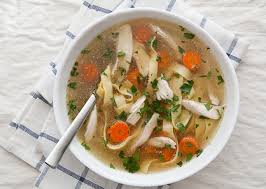
Most of you know by now that I just love soup. I inherited this gene from my mother. And this week the temperatures here in Southern California provided the ideal conditions for “soup weather”. So I looked for something new to try out. New to me, but certainly not new to most. The humble, but ever popular, Chicken Noodle Soup sounded good.
This recipe contains digestive-friendly ingredients that soothe the digestive tract. There is nothing in it that could irritate, so just like when you have a cold and aren’t well, a bowl of chicken soup is perfect for when you need a little something soothing for your insides.
Just like in my post a few years ago on that wonderfully fragrant Vietnamese soup called Pho, this soup, as nearly all of them, calls for a rich bone broth to start. If you’re short on time, you can certainly use a prepared chicken or vegetable broth, but as I stated in that article, making your own homemade bone broth is not difficult and because of the rich nutrients that a bone broth contains, it’s definitely worth making.
Here’s the recipe I made this week.
Chicken Noodle and Vegetable Soup
 Ingredients:
2 Tbsp olive or coconut oil
3 carrots, peeled and finely chopped
2 large stalks celery, finely chopped
1 bay leaf
1/2 tsp. turmeric
5 thyme sprigs, plus 1 Tbsp. finely chopped
3 marjoram sprigs, plus 2 tsp. chopped, or 1-2 tsp. dried
8-10 cups of homemade chicken bone broth
10 oz. boneless skinless chicken thighs, thinly sliced
1 cup corn kernels (frozen is fine)
1 cup rice vermicelli, broken into short lengths
salt and pepper
2 Tbsp. finely chopped flat-leaf parsley
Ingredients:
2 Tbsp olive or coconut oil
3 carrots, peeled and finely chopped
2 large stalks celery, finely chopped
1 bay leaf
1/2 tsp. turmeric
5 thyme sprigs, plus 1 Tbsp. finely chopped
3 marjoram sprigs, plus 2 tsp. chopped, or 1-2 tsp. dried
8-10 cups of homemade chicken bone broth
10 oz. boneless skinless chicken thighs, thinly sliced
1 cup corn kernels (frozen is fine)
1 cup rice vermicelli, broken into short lengths
salt and pepper
2 Tbsp. finely chopped flat-leaf parsley
Instructions:
1. Heat the oil in a large saucepan over medium-high heat. Add the carrot, celery, bay leaf and turmeric, and cook, stirring regularly, for 10 minutes, or until the vegetables have softened.
2. Add the chicken and brown a little with the vegetables. Add the herbs sprigs, broth and corn kernels and simmer over medium heat for 10-15 minutes (10 minutes if you’re using fresh or canned corn, 15 minutes if you’re using frozen).
3. Meanwhile, pour boiling water over the vermicelli noodles and let them soak in a bowl until they soften. Drain.
4. Remove the bay leaf and herb sprigs from the soup, add the noodles (*see note below) and cook an additional 2 minutes. Stir in the chopped thyme and marjoram, season to taste with salt and pepper, and serve with a sprinkling of parsley.
*You will surely have leftovers. In that case, I have found that the noodles soak up too much of the broth and get mushy the next day. What I do in Step 4 is leave the noodles out and instead, when the soup is ready, I take my bowl, put some noodles in the bottom and pour some soup over the top, and then sprinkle with parsley. I keep the noodles separate when storing them in the fridge overnight as well. So I would just add the herbs in Step 4, and leave out that bit about adding the noodles, and proceed with the rest of the directions.
For those of us with digestive issues, and even for those of us without digestive issues, fermented foods can be an important aid in maintaining the delicate balance of our gut flora.
But what is fermentation?
 Fermentation goes way back in our history. At some point, humans figured out a process to ensure that foods could be easily preserved (before refrigeration) and could be made easier to digest. The diets of every traditional society have included some kind of lacto-fermented food so news of this process must have gotten around somehow. Europeans consume lacto-fermented dairy, sauerkraut, grape leaves, herbs and root vegetables. The Alaskan Inuit ferment fish and sea mammals. Asia is known for pickled vegetables, sauces and kimchi in particular. Farming societies in central Africa are known to make porridges from soured grains.
But what exactly are fermented foods and how is fermentation different from pickling?
The dictionary defines fermentation as a metabolic process that converts sugar to acids, gases, and/or alcohol. It occurs in yeast and bacteria, but also in oxygen-starved muscle cells, as in the case of lactic acid fermentation. Fermentation is also used more broadly to refer to the bulk growth of microorganisms on a growth medium, often with the goal of producing a specific chemical product. Salt is typically used to create a brine, in which foods are allowed to “ferment” for 3-7 days or even longer.
While most people think about beer or wine when they hear the term fermentation, it is the bacteria that are responsible for lacto-fermentation. The “Lacto” portion of the term refers to a specific species of bacteria, namely Lactobacillus. Various strains of these bacteria are present on the surface of all plants, especially those growing close to the ground, and are also common to the gastrointestinal tracts and mouths of humans and other animal species.
Lactic acid is a natural preservative that inhibits the growth of harmful bacteria. Beyond preservation advantages, lacto-fermentation also increases or preserves the vitamin and enzyme levels, as well as digestibility, of the food. So before science showed this to be true, traditional societies already knew this.
Pickling is defined as the process of preserving, even expanding, the lifespan of food by either anaerobic fermentation also in brine but typically by immersion in vinegar. The resulting food is called a pickle or "pickled [insert word here]”. Pickles and relishes are a part of the American food tradition. Since the advent of industrialization, most pickling is done with vinegar, which offer more predictable results, but no lactic acid.
So really fermentation and pickling are nearly identical, as they are both methods of preserving food and contain a salt brine, although pickling includes the use of vinegar. But fermented foods offer distinct advantages for the digestive system over pickled ones because of the lactic acid.
I had read that digestion could be improved by eating a few spoons of fermented foods at the start of each meal. This would entail having a jar of the stuff around at all times. But before investing the time to making some at home, I decided to look for an example at my health food store. I had sticker shock. A 16 oz. mason jar of it cost $11.00! I did get it, in the name of research, and it was tasty, but I am not about to shell out $11.00 every time I want some, so the next step was to make it myself. And it’s a good thing - it’s ridiculously easy to do.
First on the list to try is Curried Cauliflower. It sounded zippy and a little spicy and interesting. Here’s all you need to make it.
Ingredients:
1 small head of cauliflower (about 3 cups of small florets)
2 1/2 Tbsp. curry powder of choice (you can go spicy or mild here, up to you)
4 cloves of garlic, smashed and peeled
3 Tbsp. sea salt
1 quart of water
Instructions:
1. Make a brine by heating up the water, adding the salt, and allowing it to dissolve. Allow to cool to room temperature.
2. Cut the cauliflower into small florets.
3. Place the garlic cloves in the bottom of a mason jar.
Add the curry powder followed by the cauliflower. Pour the brine over the vegetables until they are covered, leaving 1-1/2 inches of headspace. Place a lid on and shake well to dissolve the curry.
4. Place cover on jar and allow to sit out at room temperature for 3 to 7 days until fermented. You may have to burp the jar for the first few days to release pent-up gases. To do this simply open the jar until any pressure is released and immediately retighten.
Once you are satisfied that your cauliflower is fermented (it has a little tang), you can move it to cold storage.
Stay tuned - we’ll see what it tastes like later in the week!
Ok, so what’s the word on the cauliflower? I let it ferment on my countertop for 5 days since that was a happy medium between the 3-7 that was recommended. Any less and I didn’t think it would have the same zippiness. And it was surprisingly good! The cauliflower retained its crunch while having a nice little tangy curried flavor. I usually eat it as a snack when I get home from work, before I go for my walk. I take it to work and eat it alongside whatever leftovers I’m bringing. It would be a good side for a sandwich. My sister-in-law folded it into an omelet she made with spinach and kale. I might also add it to a salad or have it as a side to a bunch of Indian dishes. If you made it, what have you done with it?
With many people still buried in winter weather, it’s fitting to get just one last soup recipe in before, hopefully, the weather turns around and warms up - just in time for the start of Spring!
As you know, I love soup, and this is one of my favorites. I can hardly believe I haven’t posted it yet!
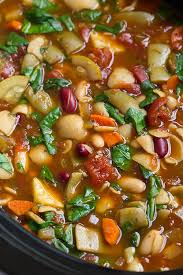
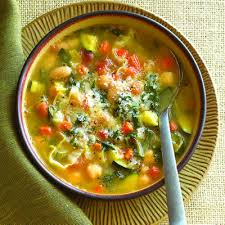 Minestrone is a thick soup of Italian origin made with vegetables, often with the addition of rice or pasta. It wasn’t until much later when tomatoes and potatoes were brought to Europe from the Americas that those ingredients were added and became staple ingredients in the soup. However, common ingredients such as beans, onions, celery, and carrots have always been part of Minestrone. The soup can be vegetarian, contain meat, or contain a meat-based broth (such as chicken stock).
It’s a soup with a thousand versions. Perhaps it’s like anything else, depending on where you go, regional influences determine what goes into it. And often what goes into minestrone is as simple as what’s on hand or in season. There are winter minestrones and summer minestrones.
For those dishes for which there is no one set recipe, we tend to like that to which we are accustomed, and for me that would be the Minestrone of my mother. I’d have to ask her where she got her recipe, but I know I wrote her version down on a little 3x5 card back in my 20’s as she dictated it to me in her kitchen one day, and I’ve still got it! Who even uses 3x5 recipe cards anymore?
Despite the fact that I love the recipe just the way it is, sometimes I add chopped greens to the soup, like chard or kale, if I have some and it needs to be used up. No matter which version you use, one thing we can all agree on is this: minestrone is often better the day after you make it. This is so simple to make and tastes so wonderful.
Here’s my family's version of Minestrone:
1/2 cup olive oil
2-3 garlic cloves, minced (really, add as many as you can handle)
2 cups chopped onion
1 cup chopped celery
4 Tbsp. chopped fresh parsley
1 can organic tomato paste
approximately 10 cups broth (vegetable, chicken or beef) or water or a combination thereof
 1 cup chopped cabbage
2 carrots, sliced
2 tsp. salt
1/2 tsp. freshly ground pepper
1/8 tsp. ground sage
1 can kidney beans
1 zucchini, chopped
1 cup green beans (frozen will work)
1 cup elbow macaroni
Parmesan cheese
1 cup chopped cabbage
2 carrots, sliced
2 tsp. salt
1/2 tsp. freshly ground pepper
1/8 tsp. ground sage
1 can kidney beans
1 zucchini, chopped
1 cup green beans (frozen will work)
1 cup elbow macaroni
Parmesan cheese
Heat oil in a large pot. Add garlic, onion, celery, parsley. Cook until soft. Stir in the tomato paste and the next 6 ingredients. Mix well. Bring to a boil. Lower heat, cover, simmer one hour. Add remaining ingredients except for the cheese. Cook 10-15 minutes more until macaroni is tender.
Sprinkle Parmesan over the top.
Serve along with the soup a nice slice of toasted Italian bread like chiabatta or focaccia, something you can dip into some olive oil. Or maybe some Parmesan crisps. For wine, I would recommend Chianti or a lighter Zinfandel - nothing too heavy. Maybe start dinner off with a simple salad of mixed greens tossed in a light vinaigrette and you’ve got yourself a wonderfully hearty, veggie-rich dinner.
If you should feel adventurous, other ingredients to consider adding or substituting:
leeks
potatoes (maybe instead of the pasta, but add them earlier on so they cook all the way)
1 can tomatoes, seeded and chopped
1 tsp fresh chopped oregano or thyme, or a little of both
1 bay leaf
fava beans
fresh peas
Tuscan kale, chopped
pancetta
summer squash
Tips: the longer something takes to cook, the longer you’ll want it in the pot cooking. For instance, if the pancetta gives off some fat, I’d use that in lieu of the olive oil at the start. Leeks and potatoes should go in early; beans, peas and squash later towards the end.


